 |
| weigela florida variegata |
Tuesday, 13 September 2011


Friday, 9 September 2011
The Shropshire Plum
It's the time of year to scour the hedgerows around Holly Grove in search of autumn fruits. In recent weeks I've spotted crab apples, sloes and damsons and have been waiting for them to ripen a little before foraging.
Then I took my eye off the ball and was distracted by our courgette glut; finally I refocused and gathered some riper than expected damsons. I say some but actually there was more than 5kg on the kitchen table when I finally managed to stop myself.

All this from two small and gnarled damson trees in our hedge; damson trees are prolific in this part of Shropshire, all over the hedgerows, no wonder they are known as the Shropshire plum. Strange and magical little fruits, too bitter to eat au naturel, they are great for making jam, cheese, chutney, liqueurs etc and they look beautiful too!
You can see what use I put them to over at Holly Grove kitchen...
Tuesday, 6 September 2011

Monday, 5 September 2011
Nasturtium Time
I planted a few nasturtium seeds a couple of years ago and ever since they've been selfseeding madly around the garden. Nasturtiums generate a huge number of seeds so there are no issues with gathering and storing or giving away.

However the other day whilst browing through a recently acquired preserving book, River Cottage Handbook No 2 Preserves, I found an unusual use for these little green seeds...nasturtium 'capers'.

So I gathered the required quantity and had a go; very easy to prepare and pickle, I'm now waiting a few weeks before I try using them in any recipe that requires a more traditional caper.
Tuesday, 30 August 2011

Friday, 26 August 2011
Harvest Time
Whoever said the countryside was quiet? Since adopting a country life I've come to realise that this is very seldom the case, there are the sounds of birds and bees, the sheep bleating in the fields either side of us, horses and riders down the lanes, hedging tools, lawnmowers, the occasional shotgun in the distance and of course, farm machinery. And at this time of the year that machinery and its accompanying symphony are all around us as the farmers make the most of the dry weather to bring in their crops.
 |
| shropshire oak in a field of golden grain |
A couple of days ago the Handyman and I decided to take a walk along one of our local footpaths; it was a glorious evening so we donned our good sturdy walking boots and set off. As we left the lane and started out along the side of a field of (what we thought was) golden barley, we were met by the sight of an enormous combine harvester finishing the gathering of the grain.
 |
| can you spot the farmer and the Handyman chatting? |
 |
| more work to do |
 |
| a rush of golden grain |
 |
| ready for baling |
 |
| baled! |
 |
| two tractors are better than one |
All of this is endlessly fascinating to someone like me brought up in the heart of the city and second nature to someone like the Handyman born and bred in the countryside. I wonder what the next crop in these fields will be?
So we continued our evening walk through the Shropshire fields ending up with a well deserved brew at our local pub and then a meander home down the lane musing on how fortunate we are to be surrounded by such production and beauty!
So we continued our evening walk through the Shropshire fields ending up with a well deserved brew at our local pub and then a meander home down the lane musing on how fortunate we are to be surrounded by such production and beauty!
Tuesday, 23 August 2011

Monday, 22 August 2011
A Lesson Learned
Last night the Handyman appeared at the french doors looking forlorn, in his hands the branch of an apple tree laden with fruit...'just found this lying in the border, too much weight for a young tree'.

It was a branch from our young Cox's Orange Pippin tree, torn off by the weight of the fruit. This year has been a bonus season for fruit and we have been lazy (and possibly greedy) in not picking off some of the fruit early to help out our young fruit trees.

So a hard lesson learned, we went out into the garden to relieve our other young trees of some apples and pears to ensure that there is no further damage.
Note: we didn't waste the apples as, although they are not quite ripe and consequently a bit tart, I made a large batch of apple puree with honey to sweeten; perfect for adding to the Handyman's breakfast cereal and some for the freezer to be added to apple pies and crumbles when proper apple-picking time arrives.
Sunday, 21 August 2011
The Colour Purple
...a great book and film, and this year the theme for some of my kitchen garden produce.
I was attracted by the seeds of the purple podded french bean, Purple Queen, when I planted them in May of this year. The plants have rewarded me with foliage that is green with a purple tinge, really pretty purple flowers and then the beans themselves. Like many french beans they do not grow very tall, about 60cm, so they don't need much in the way of support. They do seem to be producing a decent crop, though not prolific...perhaps if I watered them more frequently, a constant cry in the garden this summer.
When prepared for the pot they make a lovely contrast to the bright green of our runner beans, however when cooked they revert to green. Flavour wise, they are tender and tasty. I will grow these again next year, if for nothing more than the purple flowers and the liquorice stick beans.
Note: The purple pepper in the photo is F1 Mavros, very attractive in the greenhouse alongside Mohawk, an orange pepper and red pepper, Thor. Both Mohawk and Thor fruits are still green at the moment, photos and post to follow when they change colour.
 |
| a handful of Purple Queen french beans for our evening meal...oh, and more courgettes! |
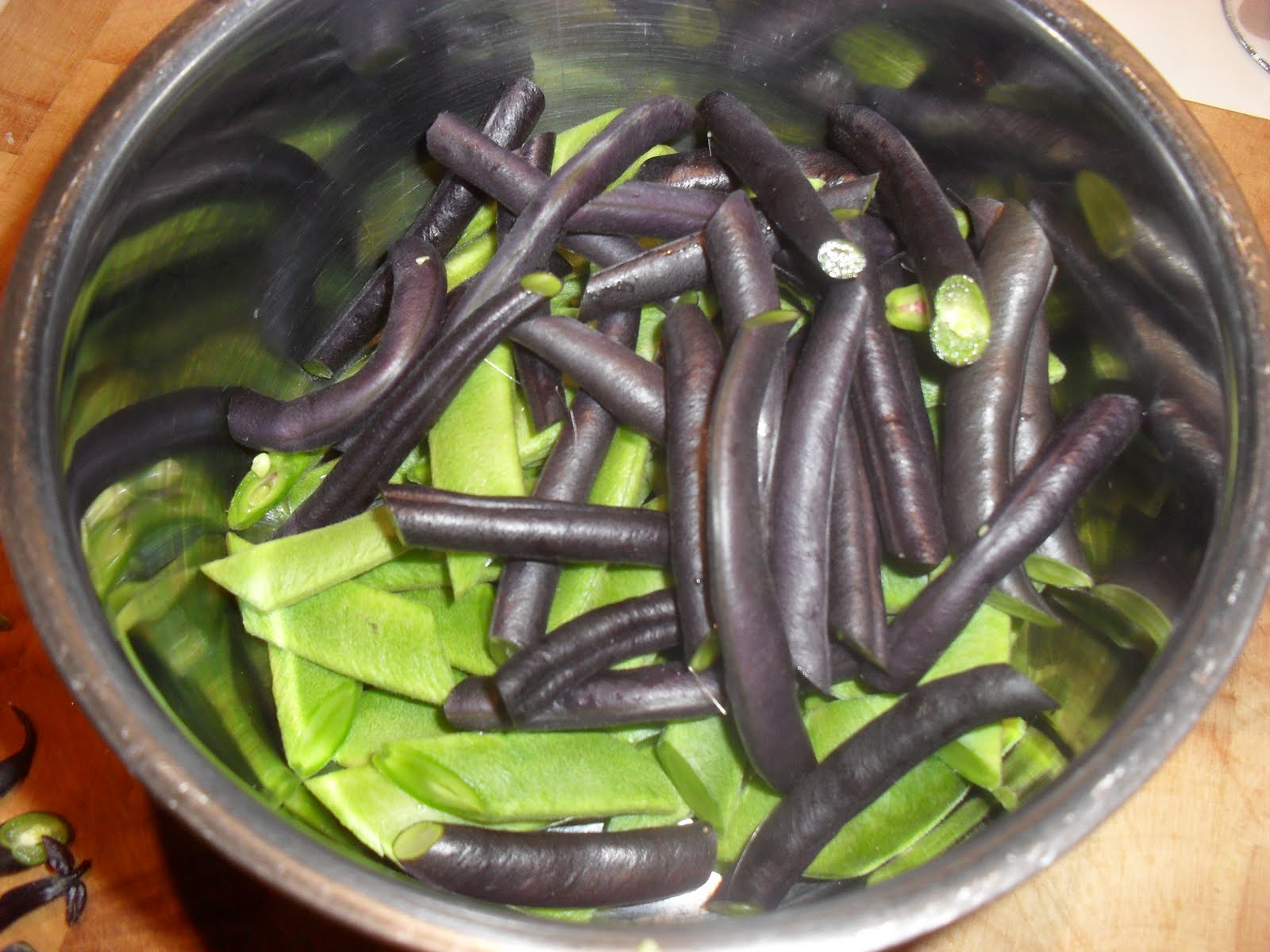 |
| contrasting colours...before cooking |
Note: The purple pepper in the photo is F1 Mavros, very attractive in the greenhouse alongside Mohawk, an orange pepper and red pepper, Thor. Both Mohawk and Thor fruits are still green at the moment, photos and post to follow when they change colour.
Saturday, 20 August 2011
Made with Love (VFTA No 6)
There is a garden on the borders of Shropshire, Staffordshire and Cheshire, tucked away in the countryside that I've wanted to visit ever since I read the story of its creation. The story of this garden tugs at the heartstrings and ensures that any gardener with a romantic bent would want to visit to see the results of this garden made with love.
The Dorothy Clive Garden was begun by Colonel Harry Clive in 1940; it was to be a garden where his wife Dorothy, who suffered from Parkinson's disease, could take some daily exercise. Sadly Dorothy died in 1942 but Colonel Harry continued with work on the garden in Dorothy's memory. In 1958 the Colonel set up the Willoughbridge Garden Trust as a memorial to Dorothy and to provide a place of rest and recreation for the public. Harry died in 1963 leaving a beautiful garden for us to enjoy.
So you can see the appeal of visiting this garden - will the planting be as romantic in nature or will it be more formal as may befit the era in which it was begun? My friend and fellow garden addict, A, and I set off from Holly Grove on a sunny Saturday morning to find out.
On arrival and parking the car I was struck that there seemed to be no garden visible, but following the entry signs we were soon under the tree canopy and climbing the grassy slope; soon the path spilt and we had several choices. Although we had been given a map of the gardens on entry we decided rather to wander where our fancy took us, and so meandered along paths of gravel and grass.
The planting at this time of year in the open areas of the garden consists of grasses, salvias, eupatorium, dahlias, sunflowers, rudbekia etc making colourful displays and, on our visit, swaying in the breeze.
Following our instincts we eventually made our way out of the sunlight and down into the quarry garden. This garden must be stunning in late spring as it is predominantly planted with rhododendron. The tree canopy is quite dense but very high and the quality of cool light is lovely; then around a twisting path...a small but perfectly formed waterfall!
Walking up the paths from the waterfall we had another surprise awaiting us...a magnificent stag in the woods...
Then onwards and upwards and back out through the laburnum arch and past the azalea walk (more reasons to visit in late spring) onto a wide grass path leading to another viewing point. This time the view was across farmland right at the top of this steeply sloping garden.
So having made our way from the bottom to the top of the garden via the quarry we headed for the tearoom for a much needed cuppa, not to mention the carrot and St Clements cakes: homemade, delicious and heartily recommended!
Next to the tearoom is a small plant sales area. All the plants looked healthy and were reasonably priced but, unusually for me, nothing took my fancy - the Handyman will be shocked!
Following our stop for refreshments and a good old chat, we set off back down the hillside through the gravel garden. Then reaching the pond we looked upwards towards the top of the garden and the vista of mature trees.
The garden has lots of places to sit, many of them with great views of the garden and surrounding countryside. They are needed as the paths can be steep. Although spread over 12 acres the garden is surprisingly intimate. Like many gardens in this part of the world some of the planting is suffering from a lack of water but overall we enjoyed our visit and will ensure that we go back when the rhododendrons are in bloom.
The garden is a lovely and fitting memorial to both Dorothy and Colonel Harry!
The Dorothy Clive Garden was begun by Colonel Harry Clive in 1940; it was to be a garden where his wife Dorothy, who suffered from Parkinson's disease, could take some daily exercise. Sadly Dorothy died in 1942 but Colonel Harry continued with work on the garden in Dorothy's memory. In 1958 the Colonel set up the Willoughbridge Garden Trust as a memorial to Dorothy and to provide a place of rest and recreation for the public. Harry died in 1963 leaving a beautiful garden for us to enjoy.
 |
| our first proper view from the first level across the pond and Staffordshire countryside |
On arrival and parking the car I was struck that there seemed to be no garden visible, but following the entry signs we were soon under the tree canopy and climbing the grassy slope; soon the path spilt and we had several choices. Although we had been given a map of the gardens on entry we decided rather to wander where our fancy took us, and so meandered along paths of gravel and grass.
 |
| meandering gravel paths lead you through the garden |
 |
| pale lemon sunflowers and helenium make a lovely picture |
 |
| ferns and that lovely sound of falling water |
 |
| impressive garden wildlife! |
 |
| golden harvest |
Next to the tearoom is a small plant sales area. All the plants looked healthy and were reasonably priced but, unusually for me, nothing took my fancy - the Handyman will be shocked!
 |
| I would have bought one of these if they'd had some - no label, so no idea of plant name |
 |
| from the pond back up the hill |
The garden is a lovely and fitting memorial to both Dorothy and Colonel Harry!
Subscribe to:
Posts (Atom)